🚀 Introduction
If your business depends heavily on you, chances are you’re blaming your team.
- “My team lacks ownership.”
- “I have to follow up on everything.”
- “No one takes responsibility.”
So naturally, the solution seems obvious:
👉 Hire better people
But what if the real problem isn’t your team at all?
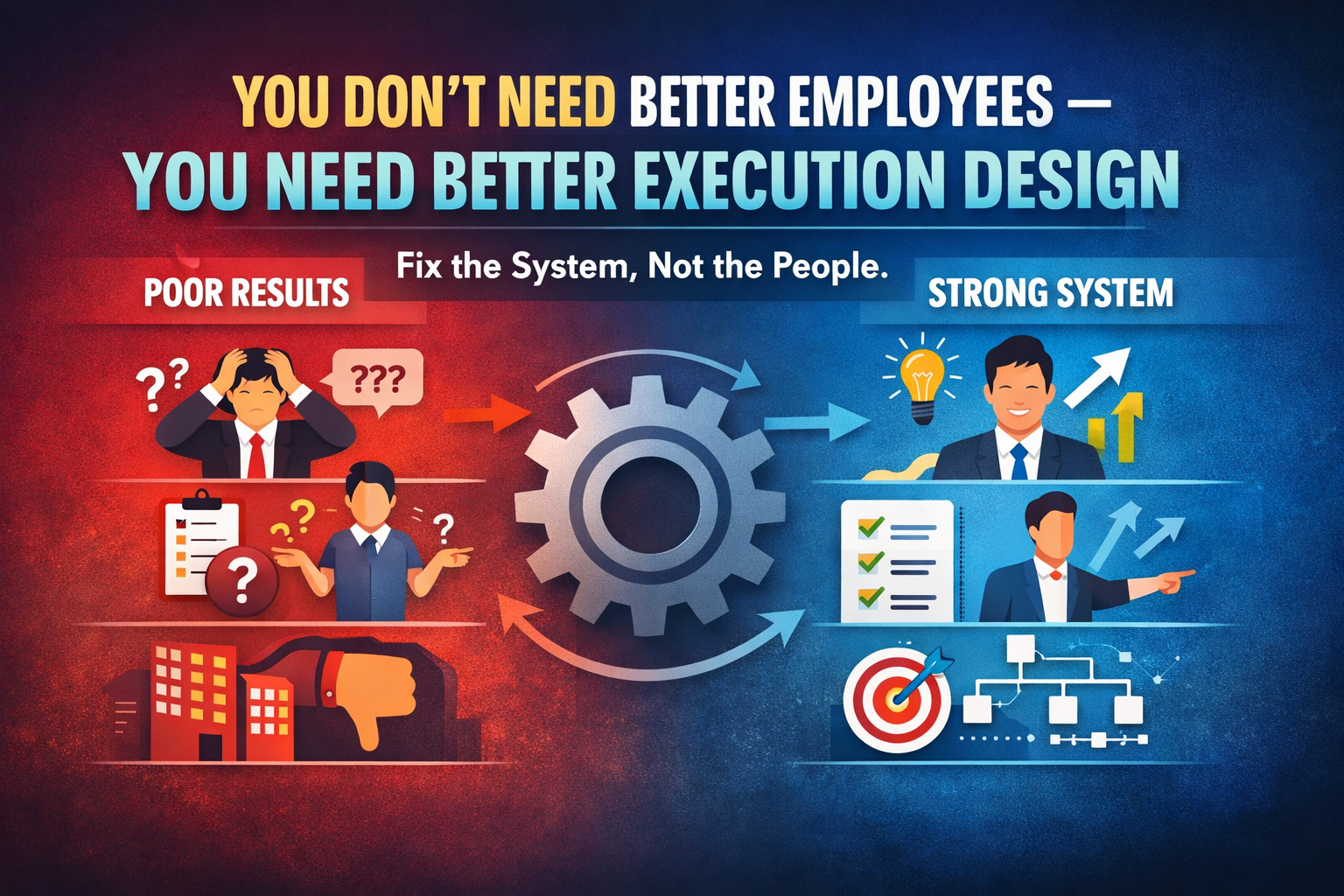
Most growing businesses don’t have a people problem – they have an execution design problem.
🔍 Why Your Team Is Not Performing (Even If They’re Capable)
Let’s be clear – most teams are not incompetent. Your team:
- Shows up daily
- Understands their role
- Wants to do their job well
Yet you still experience:
- Constant follow-ups
- Repeated mistakes
- Decision delays
- Dependency on you
Why?
Because execution is not designed – it is managed manually.
⚠️ The Hidden Problem: Poor Execution Design
In many businesses, execution runs on:
- Verbal instructions
- WhatsApp reminders
- Daily pushing
- Founder involvement
Instead of:
- Defined ownership
- Decision clarity
- Structured reporting
- Consistent execution systems
This leads to:
❌ Confusion ❌ Dependency ❌ Low accountability ❌ Slow growth
And the founder concludes:
“I need better employees.”
🧩 What Is Execution Design?
Execution design is how work moves inside your business without constant supervision.
It answers critical questions like:
- Who owns what outcome?
- Who can take which decisions?
- How is progress tracked?
- How does work flow daily/weekly?
Without clear execution design, even talented employees will underperform.
🧠 Real Example: Same Team, Different Results
Company A (No Execution Design)
- Tasks assigned verbally
- No ownership clarity
- Decisions escalate to founder
Result:
- Delays
- Follow-ups
- Frustration
Company B (Strong Execution Design)
- Clear ownership
- Defined decision authority
- System-based reporting
Result:
- Smooth execution
- Independent team
- Predictable output
👉 Same people. Different system.
⚙️ 5 Elements of Strong Execution Design
To improve team performance, focus on these five areas:
1. Clear Ownership
Every outcome must have one owner (Not “team responsibility”)
2. Decision Authority
Define who can decide what Without involving the founder
3. Reporting System
Updates should come to you Not the other way around
4. Execution Rhythm
Work should follow a structure Not reminders
5. Feedback Loop
Problems should be fixed at the root Not repeated weekly
🚨 Why Hiring More Employees Won’t Fix This
Many founders believe:
“If I hire better people, everything will improve.”
But here’s what actually happens:
- New hires face the same unclear system
- They get dependent too
- Execution remains broken
👉 Because the environment didn’t change
📈 Why This Becomes Critical as You Grow
In early stages:
- Effort works
In growth stages:
- Complexity increases
- Decisions multiply
- Coordination becomes harder
If execution is not designed:
👉 Everything comes back to you 👉 You become the bottleneck 👉 Growth slows down
🔄 The Real Shift You Need to Make
Stop asking:
❌ “Why is my team not performing?”
Start asking:
✅ “Have I designed execution properly?”
💡 Key Takeaway
People don’t fail first – execution design fails first.
Once the system is clear:
- Ownership improves
- Dependency reduces
- Performance increases
Without changing your team.
📌 Conclusion
If your business still depends on you for:
- Decisions
- Follow-ups
- Problem-solving
Then the issue is not your people.
👉 It’s your execution design.
Fix that – and everything else starts aligning.
🔗 About Upgrade India
At Upgrade India, we help businesses build execution systems that reduce dependency on the founder.
Using the HELIX Execution Framework, we focus on:
- Ownership clarity
- Decision systems
- Execution flow
- Scalable structures
📣 Final Thought
Your business should run on systems – not on your effort.