Introduction
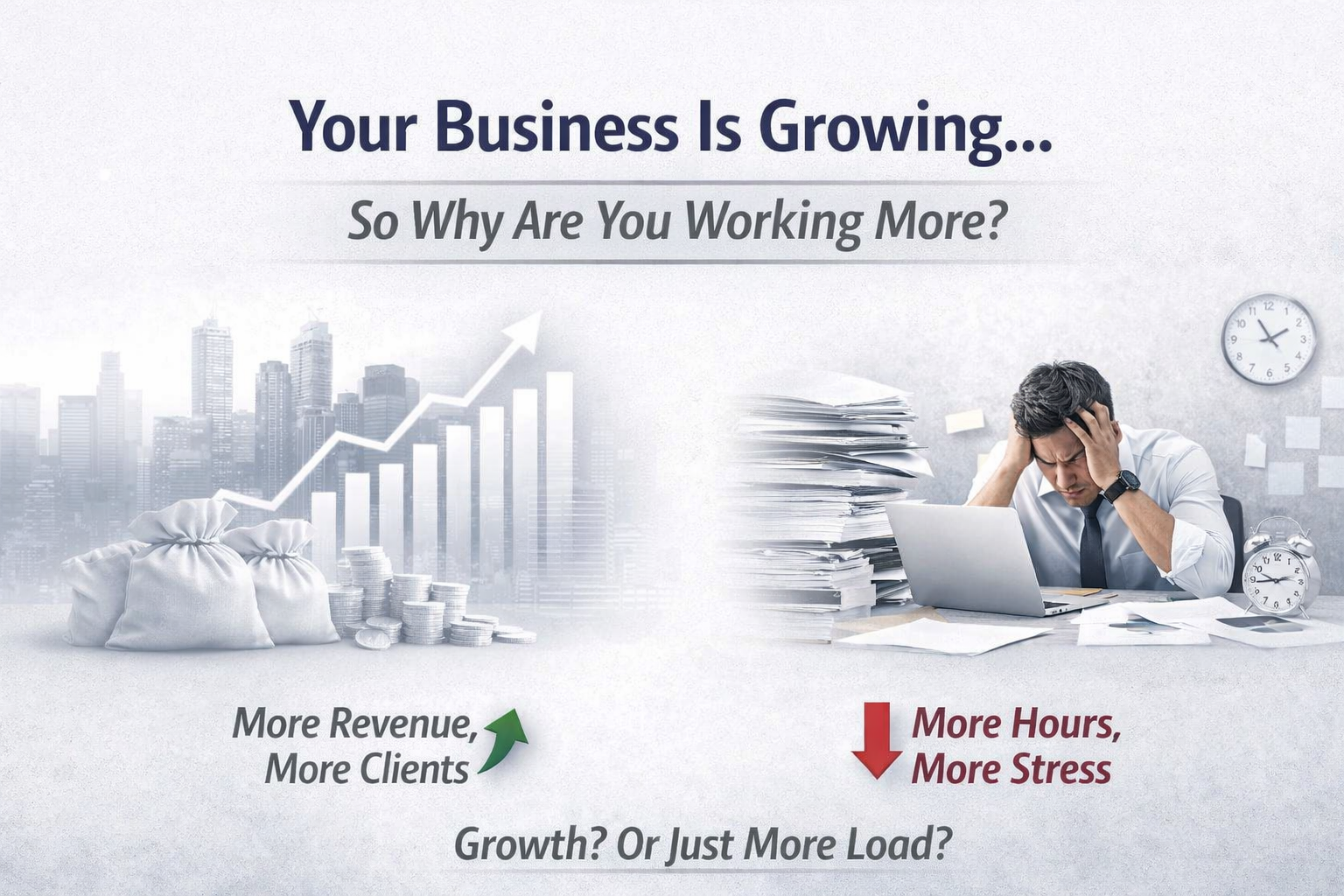
Growth is supposed to feel like progress. More clients, more revenue, more opportunities – everything moving in the right direction. But somewhere along the way, many founders notice a strange shift. Instead of feeling lighter, they feel heavier. They are working more hours, handling more decisions, and constantly following up on things that should have been taken care of. And the thought quietly starts forming:
“Business badh raha hai… par mera load bhi badh raha hai.”
The Reality Behind This Pattern
At first glance, this feels normal. Growth naturally brings more work. But here’s what most people miss – growth should increase results, not your personal workload. When your effort increases along with growth, it is not a sign of success. It is a signal. A signal that your business is still dependent on you to function. As the business grows, so do the number of tasks, decisions, and coordination points. If these are not structured properly, they all begin to flow back to one place – the founder. And that’s where the real problem begins.
Why Growth Starts Feeling Heavy
In many growing businesses, execution is not designed – it is managed manually. Work moves because the founder pushes it. Decisions happen because the founder approves them. Problems get solved because the founder steps in. From the outside, everything looks fine. Revenue is increasing, the team is active, and work is getting done. But internally, something is off. The founder is more involved than before. Thinking time is reducing. And instead of scaling, the business is quietly becoming more dependent. This is not true growth.
This is an effort expanding with size.
It’s Not Always a Team Problem
At this stage, many founders assume the issue lies with the team. They feel people are not taking ownership or not thinking independently. But in most cases, the team is not the root problem. The real issue is that the system does not allow independence. When ownership is unclear, decisions are undefined, and progress is not visible without asking, people naturally wait for direction. Not because they lack capability, but because the structure does not support autonomy.
The Cost of This Dependency
If this pattern continues, the impact becomes serious. The founder gets stuck in operations. Strategic thinking takes a backseat. Growth starts feeling stressful instead of exciting. And most importantly, the business reaches a point where it cannot grow beyond the founder’s capacity. At that stage, it doesn’t matter how big the opportunity is – everything is limited by how much the founder can handle.
The Shift That Changes Everything
The solution is not to work harder or hire more people. It is to shift from managing work to designing execution. When execution is designed properly, things start to change naturally. Decisions begin to move downward. Ownership becomes clearer. Updates flow without chasing. And the founder is no longer required in every step. The team does not suddenly become better. The system becomes clearer.
A Simple Way to Understand Your Situation
Instead of looking at revenue or team size, ask yourself a few honest questions. How many decisions still come to you every day? How often do you need to follow up? If you step back for a few days, what will stop or slow down? The answers to these questions reveal whether your business is actually scaling – or simply increasing your workload.
What Growth Should Actually Look Like
Real growth is not just about expansion. It is about reducing dependency. As your business grows, your involvement in daily execution should reduce, not increase. You should be moving toward clarity, control, and strategic thinking – not deeper into operations. Because if everything still depends on you, then growth is not freeing you. It is trapping you.
Conclusion
If your business is growing but your workload is also increasing, it’s time to pause and reflect. This is not just a phase. It is a structural signal. Your business is not lacking effort. It is lacking design. And once execution is designed properly, growth starts feeling different.
Lighter. More predictable. More scalable.
Final Thought
“If growth needs more of you, it’s not scale. It’s a dependency in disguise.”
Upgrade India
HELIX Execution Framework We design businesses that grow without depending on founders.